Photos

All photos on this blog, Wildlife on Wheels, are taken by me. If you want to use any of my photos for anything other than personal use, send me an email and we'll talk about it. The email address is listed in the sidebar on the right .

Save Dunmanus Bay

Showing posts with label Spders. Show all posts

Sunday, October 3, 2010

Zebra Spider, Salticus scenicus

Zebra Spider, Salticus scenicus


Jumping Spider males will perform a courtship dance in which they not only wave the front legs, but "but femaleswill pick up the rapid vibration when the dancing male pushes down his abdomen. You can see this dance of another jumping spider specie, in this video.

And if you scroll down to the (almost) bottom photos here, you can see great photos of the Male (right) and Female (left picture) of our Salticus scenicus. The fangs of the male look enormous, which make me think that I got 2 females.

Ajumping spider does not catch its prey in a web, but instead it will stalk its dinner and pounce. Just before the jump, it will attach a silk thread, so it could always get back.

If you are intrigued by Spiders like me, and would love to find names to the pictures, the Spiders of North west Europe is a nice website with lovely photos. At the bottom of the Home Page is a list of other eight legged websites globally.
I love the little Zebra Spiders. As regular readers of Wildlife on Wheels will know. I have a few living around the outside walls of the house, and last year had one inside the kitchen. Despite their 5-7mm size, I usually spot one daily. Whenever I get outside, I do stop at the wall next to the porch, to check if one is there.
And of course, it would not pose for the camera, but rather keep on going wherever they think they need to go. With an incredible speed, while I follow it with the camera!
Another one lives on the other side at the front, always I haven't seen it for a couple of months now. I'm fearing it might be gone, as there were Grasshoppers and the much bigger Garden Spider, living in that corner of the garden also.
I saw them both at the same time in summer, otherwise I might be doubtful it being two different spiders. I've tried looking for individual features, but they are so small, that it is very hard to see on my images, and so I keep guessing.


Also, they are very curious and will often lift their head to observe that silly human who is watching this spider!


This Zebra spider I captured last year on my back wall. So I might have 3 about the place; mind you, I would not be surprised at all, if my one next to the porch had moved north to the back of the house, very near where I took most of the above pictures.

And a Meta segmenta, I'd think. Please correct me if I'm wrong.

Saturday, August 14, 2010

Long legs and a couple of flyers too.


If you know any identities of any of these species, could you leave a comment in the white box below, please?

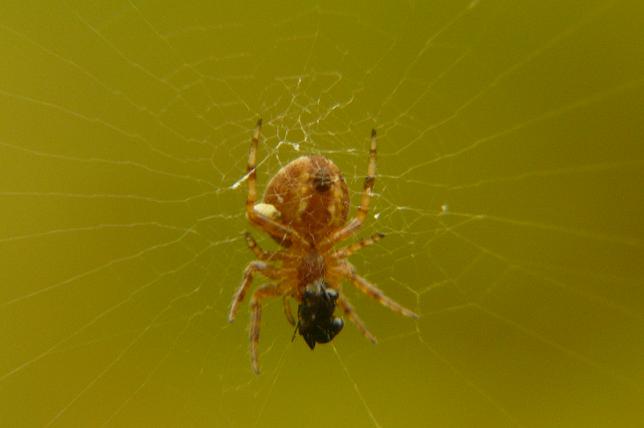
One of the many spiders in the garden. Taking full advantage of the winged critters which get entangled into their webs.


OK, I know; last post featured Spiders too. With all the rain we've had, they are the most prominent among the leaves of the Nettles and Bramble, as they set about repairing and weaving their webs.

Passing the Bramble (with nice juicy black berries at the moment) I spotted this Spider having a big meal out of this Fly, which she had wrapped earlier.)


Garden spider?
Usually it is only the undersides you get to see of Spiders as they sit in their webs.


This scary, yet colourful, Fly was big t 20-222mm. I spotted it in one of the Hebes at the garden at respite, where I was searching for Inects. normally you see very few about the garden, other than houseflies, that is.
It was very orange, which was lovely against the little green leaf of the Hebe. I was surprised to find any Invertebrates there at all; hebes look not very Insect friendly to me! There were some little spiders among the branches also, so there must be food.

While I sat taking photos of Ladybird A, on the right leaf, Ladybird B, here on the left leaf, came running up the stem, around each leaf, until it stopped to catch a breath of Carbon dioxide. (from my breath) not particularly fresh, I'd think!
Anyway, these are two 7-spot Ladybirds, Coccinella 7-puncta
Apparently, the C-7, as the 7 spot is the specie is called also, is the most common Ladybird in Europe.

This Insect, is a stranger to me; it looks as if it is neither hoverfly, nor hopper either. it moves from leaf to leaf with such speed, that i only see it, when it is almost leaving the 2nd leaf, for number 3. Getting a picture was very difficult indeed.
Any ideas as to its identity? I'd really welcome any of these in the comment box, underneath this post.

Friday, July 30, 2010

Garden Ants: Nuptial Flight of the females

Female Garden Ant, Larus niger trying uot her wings to fly for her first and only nuptial flight.
Only the females in the colony will fly out.


here you can see the size difference between an ordinary worker in the colony and female members of the Ant society. Females will grow wings, mate and set up new colonies. Not all of these will be succesful though. The new queens will become major egg-laying machines, so to speak; hence the large body. After mating, she wil store enough sperm for the rest of her life. Being able to lay millions, if not more, eggs to help guarantee the future of this successful specie.
An interesting fact: The global Ant population weigh as much as the human population does.!

They time their nuptial flight to just the right temperature, time of year (usually late july or early August) and level of humidity too, perhaps? That it needs to be dry speaks for itself, as they had trouble enough already, it seemed.

After about 3 weeks of wet weather where we had either showers or lashing rain, with dry intervals now and then. The wind had been strong during most of this year's summer too, keeping me from rides on the road for a lot of these months.
Last Monday, there was a change in the weather. It was close, no breeze at all, and I had a peculiar feeling all day. Then at about 5pm, Nina (our cat) went through the kitchen door, going outside for a quick wee before tea. As she went out, I saw a flutter of winged Insects flying up from what I assumed was the path under her feet. They all fluttered up into the air. Flying up was too big a word for the way they went, up.
As I sat in the doorway, i spotted these female Ants pushing themselves out of the lock of the door. They had wings alright, but that did not mean that they were able to fly yet! Winthin a few minutes, I was covered in very large Ants, flapping the wings; unsure what to do with these.
They walked up the door frame, thinking that height would help them in take off. Soon, most fell off!


Just outside of the door, tiny Spiders were waiting in anguish; they must have recognised the time in summer, and were waiting for the unlucky ones, whose legs would let go too early.

You cannot see much here, but look at the two white eyes of the Spider, as it takes a look who has offered itself to be his/her next meal.
They had a field day! Probably for days/week9s?) on end. They weer tiny in comparison to the Ant. Unfortunately, it was too windy for sharp images; they kept swinging from end to end.


Here the Spider is wrapping its catch laboriously.

Tuesday, July 6, 2010

Zebra Spider, Salticus scenicus

Zebra Spider, Salticus scenicus

They are known for their curiosity, in that they often lift the head to observe us, humans.

. And with 2 very large, and six smaller eyes, these little jumping spiders are fierce predators. Females will be between 5-8mm longand males come in at about 5-6mm. The

Before they jump onto their chosen prey, the Zebra Spider will fasten a thread; this way they will not fall down when jumping.
The mother will stay with her egg sac and protect her hatchlings until the spiderlings have had their second moult.

Tuesday, June 29, 2010

Hopper and Spiders among today's Critters in the garden

Interesting Spider, hiding amongst the pebbledash of our front garden-wall.
no idea which species this is, of course.

Nina, the cat, had been playing with, or at least bothering it behind my back, as I sat taking pics of the
Spear Thistle, Cirsium vulgare


Flower petal of the Dockweed, suspended among Sea Bindweed.


Ladybird larvae.


Ladybird larvae.
And another one.

I found three larvae in this stage of development. I think that these are different specie than the larvae featured in last week's Macro Monday post, Nettle and Grass, because here I spot a yellow spot in the middle of the back, between the two spots on either side.

Grasshopper.
There were at least 2 of them in a space of 1.5m x1.5metre. And I did have to get right into the grasses and Bird'sfoot in order to get these shots.
Garden Ant on Common Bird'sfoot Trefoil, Lotus comiculatus, flower.


This Wasp sat very still on a bag of compost. It seemed as if the wings were unable to move.

Monday, September 1, 2008

Insects and Diggers

Last Thursday I did manage a couple of hours on the road, less birds than I’d hoped to see, yet the Sun was nice and warm with a bit of a rough breeze. This meant that many Wild Flowers were moving their beautiful heads a little too fast. Yet all those I did manage to shoot had a squatter of some kin. Most were Bees and a few Wasps or Hoover-flies also.
Of course there did the usual numbers of tourists also, need directions to certain parts on the peninsula or wider area too. Most solo males are French and most females German. Brits favour walking in small family groups I’ve yet to encounter an American tourist walking.
I also came upon 4 dug up areas; along the high backroad, 4 holes were dug by an animal, among the Montbretia, Nettles and Wild Carrot (no, too big for a Rabbit!) and I think this was in an effort to get underneath an electric fence. Behind the fence? A very large field. It looked like the culprits would have been the size of a Badger or a Fox. The question is why are there four, with 100cm in-between the dug up areas. And very much near a house too. The one nearest had its occupant enjoying the Sun, my meowing wasn’t up to scratch that day, as my cat had told me in the morning!
For Crow and Border Reiver I was delighted to get a couple of images of Hooded Crows four of which were basking in the Sun on top of the pier. An incoming fishing trawler scared them off and also a pair of Pied Wagtails, walking the walking the wall protecting drivers from going for a swim in the bay. What amazed me though was that no Heron, Blackheaded or any of the other Gulls were following the boat. These Wagtails love the water too. I often meet them here and yet they are always teasing me in flying off as soon as I get my Lumix out. Two of the four Hooded Crows were looking down on me from the streetlight, they had flown when the trawler approached the pier, with the other pair allowing me just one or two pictures from quite a distance and although I kept the camera in my hand, so I would be able to take one as soon as I had closed in a little, it was all I was going to get.

As I rode up the hill home, I realised I had not seen a single Butterfly, nor a Moth. I’d seen these about in a much stronger Wind before, and it had not been dull either.


Apart from this, back home I found a Moth the next day and took some more pictures of the Garden Spider which had taken occupancy of my window in the kitchen. This was awkward as I needed to clean my window on the outside if I wanted to keep photographing the birds in my garden. It had woven its web from side to side and after the rain of the last few days, I already had trouble getting clear images of those hauling as much food as possible, now they did not need to pose for herself behind that window.
I really liked the Garden Spider a lot, yet I also wanted to take advantage of the dry weather to wash this piece of glass.
I really did not want to dislocate this beauty, and in the end I managed to open the window inwards and when my creepy crawly had not run off nor the web loosened, I decided just to wash the corner I use most. This might explain the speckled background in the images of the web threads. I am still experimenting with my Lumix and this Spider and web bode another opportunity to see how detailed the in-built macro features are.
See for yourself. The trouble is that I’d rather go for much more detailed images, yet the big challenge would be how well I would be able to cope with a DSLR with just the one hand. Living as remote as we do, trying out in a shop would have to wait for a year at least! So that is not an option at the moment. Besides, money is the biggest problem, of course.

A little view down the high back roadInsects seemed to sit on every Wild FlowerWho has been diging here?
four Hooded Crows, 2 flew offOnly one pair of Mute Swans near the church of ireland.GardenSpider back home