Photos

All photos on this blog, Wildlife on Wheels, are taken by me. If you want to use any of my photos for anything other than personal use, send me an email and we'll talk about it. The email address is listed in the sidebar on the right .

Save Dunmanus Bay

Showing posts with label Butterflies. Show all posts

Wednesday, September 8, 2010

Small Tortoiseshell Butterfly, Aglais urticae

Small Tortoiseshell Butterfly, Aglais urticae


At some time in summer, as I was observing and photographing Insect larvae among the Bramble and Nettle, I suddenly spotted the emergence of Small Tortoiseshell Butterflies from the Nettle/Bramble brush a couple of metres from me. There were two at first. Then 2 more, and on it went, one pair at the time, flying up from the same place, and away over the roof of the house (1 storey) to the south or westwards. What really surprised me was that they kept emerging in pairs.
I don't have photos from that day, but I've seen a lot of Small Tortoiseshell this summer, and other people also tell me that they have seen more than last year.


Thursday, June 10, 2010

A bit of Mixed Bunch, really.

I have encountered quite a few unidentified Moths by now. Here are just a few. Most of the time we have a number of Small Magpies inside, ranging from 7 to 4. Added to these we got another species too, waiting to be discovered, and helped outside again, after one or two pictures.

On one of my rides on my local patch, I spotted a this beauty. Sitting in the bush.
Found this a few months ago, actually.

This one sunning itself on a rock with Moss, Lichen and Stonecrops around it. What an ideal habitat! It was almost transparent.


This one looks almost like a wooden toy plane. At first I thought it could be a pale form of one of the Thorns, like the Early Thorn, Ennomos quercinaria, but its behaviour in resting position were very different. The Thorns that I've seen here, would keep their wings closed like a Butterfly would rest with the wings closed.


A Buff Ermine, Spilosoma lubricipeda was caught by Francis when I was in bed, and one is in the kitchen again tonight. Just a few nights later.

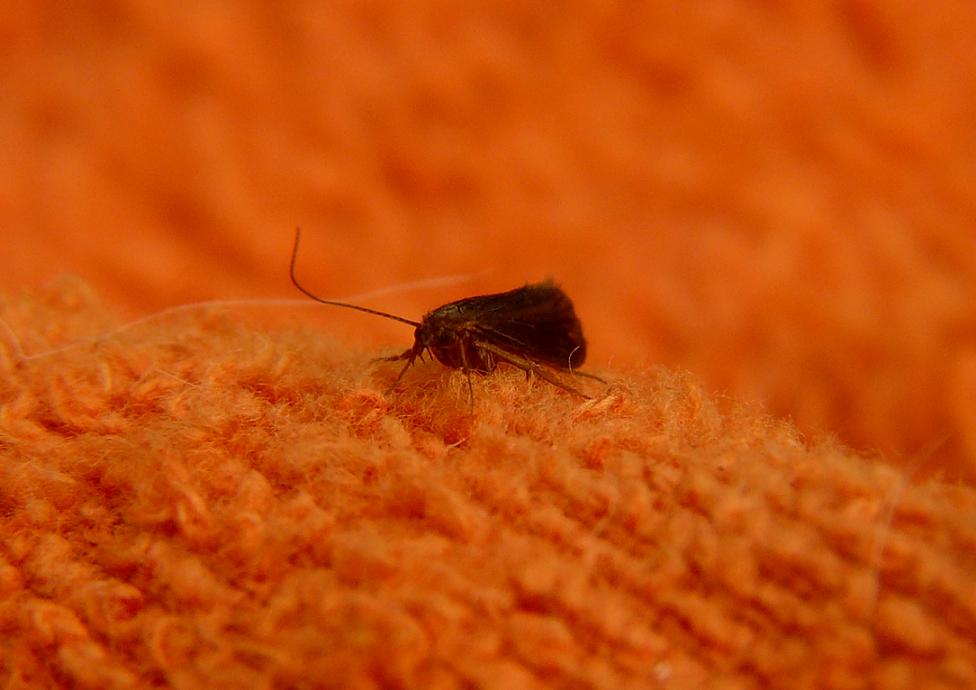
This little brown micro caught me, so to speak, when I was photographing other life around the garden and it landed on the towel over my legs. I had been thinking a few minutes earlier that I do need to take small pots or jars with me when I go outside these days. As I went backwards to get a few jars and my macro lens, , this Moth took a liking to me and I was way too late. I was unable to get a closer look. How sad. Perhaps it just took a shining to the rusty orange and how well it would look colourwise.


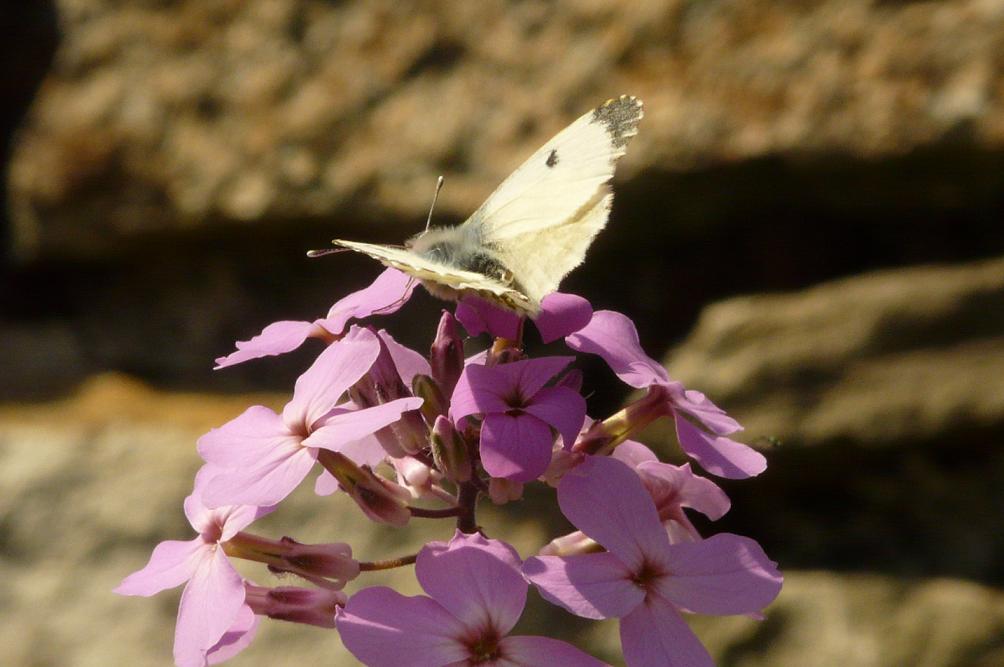
Along thebackroad I sat watching the plants when this lovely Butterfly landed on an empty packet of crisps. It was no coincidence; it seemed to land there directly. At first I assumed it was a late female Orange Tip.

Until I saw the underside. It doesn't look like a Green or Black Veined Butterflies, either. nor like the large or Small Whites. Oram I overlooking details?


I also found Ragged Robin, Lychnis flos-cuculi

In Dutch this is called the real Cuckoo's Flower.

Yellow Flag Iris, Iris pseudacoris
Again, the rain has ruined them mostly this year.


Cork-screw Grass & Fern.


Early stages of Arum Lilies?


Friday, May 21, 2010

Orange Tip Butterfly.

female Orange Tip, Anthocharis cardamines,

If you look closely, you'll see the proboscis curled up, because this female has either just landed, or finished feeding on the nectar. (and no, these 2 pictures are not the same photo!)


I love that hairy look of butterflies and Moths. Many Moths add featherly antennae to this look, making them even more attractive!
The Orange tip male has two orange tips on each forewing; the female, as you can see here, has grey tips with faint orange border.


She kept flying about the plant, checking out each flower, and yet, after a lot of flying about, it would return to the same two flowerheads. She was very obliging and despite flicking the wings a lot, she was my ideal posing Butterfly.

I had seen a lot of Orange Tip males around the same spot, . (about 200m from my home) yet they never gave me the opportunity for a picture.

I wanted to add a few more photos. I have Blogger problems however and I'm unable to get the picture button working (on both blogs)

Wednesday, October 21, 2009

Migrating Butterflies; Red Admiral, Vanessa atalanta, Butterflies

In a Glengarriff Woods I spotted this late Red Admiral, Vanessa atalanta, 7 days ago. It was fuelling up for its long journey south, or was it? Like its Thistle loving cousin, the Painted Lady Butterfly, Vanessa cardui, the Red Admiral is also a migrant species. Scientists and wildlife enthusiasts, however, are still wondering why it is that we do not see a mass migration out of Ireland and UK like the large numbers of Butterflies we saw this spring, coming into these islands. This topic was raised in Autumnwatch too, recently. As a result of the discussions and the scientific research, viewers have been asked to help in leaving a mark on the inter-active map, of where they have seen Autumn Painted Lady Butterflies in the UK, Ireland, Scotland or Wales. There are also charts to mark sightings of the Hummingbird HawkMoth, Macroglossum stellatarum. There have been a great many sightings; on the North European mainland also. This month only two Irish sightings; one in Northern Ireland near Maghera and the other was sighted around Clifden in Connemara in the West of Ireland.

But what of the Red Admiral Butterfly? Although a migrant species from North Africa and the Med, Butterfly Conservation stated that recently the speie has been found overwintering in the south of the UK.
Here in Ireland? I don't know yet. I still have to start looking for an answer to this. I assume many do spend the wintermonths down south, in Ireland too. If you look at the scientific name for the Red Admiral- Vanessa atalanta- it has always been a migratery Butterfly, assuming that atalanta can only really mean, Atlantic?

Red Admiral, Vanessa atalanta
Glengarriff Woods
Glengarriff Woods, County Cork
Last week I spotted the one above in Glengarriff Woods Nature Reserve, and tthe two Butterflies in these pictures I spotted over last weekend, down here at home. A new yapper (small dog) at one of neighbours, kept jumping up at my legs and its yapping/running about meant that the Butterflies got really 'jumpy' and scared of the ***beast. It runs about as a young pup, and I suspect it is. I just get very annoyed with it, everytime I get out of my gate and it starts running in front of my front wheels. I cannot jump onto a road from the path, or the other way around, to avoid this noisemaker,
, County Cork
County Cork
County Cork

Saturday, July 25, 2009

Ringlet Butterfly

Everyone has seen Painted Ladies, those beautiful orange Butterflies with their different shaped wings, this spring. All over the UK, Ireland, but here.

What I do see a lot is the Ringlet Butterfly, with its beautiful pale borderline around the wings. This one landed on the bindweed next to the wall. Luckily my wheels elevate too, raising me and my camera above the nettles, so I was able to take some pictures.
Due to the strong breeze, (there had been a gale warning the day before! ) its wings kept fluttering and it had trouble to stay put. Poor thing. Actually recently I have been surprised to see Butterflies (and Moths) out, attempting to find a way how they can use this breeze to their advantage.
But just imagine that you leave your cocoon behind, open up your new wings, trying to get the feel of them and you are immediately lifted from where you sit, out into the big wide world of airspace! You flap your wings as hard as you can, try to steer but you're just going from left to right against your will. And besides this, you are very very cold!
no wonder I never liked the wind. I do see little Plume Moths drifting by the window now and then. Drifting on the wind, like a seed parachute. And then there is the rain....
No, we the ones who enjoy voyeurism into the world of nature, might keep complaining about the wet, wild and wind which has been this summer's norm of the day, but do we have only the slightest idea of how difficult it is to survive in weather like this, when you are an Insect? You not only need to survive; you also need to pack in loads of other activities. Foraging, searching for a mate, mate, lay eggs, defend yourself from predators, and most of all: Get to recognise these predators before you get eaten.
I have great respect for this minute world of wonder, shape, colour and beauty.

Ringlet Butterfly, Aphantopus hyperantus


A pair of Bluebottle flies,Calliphora+vomitoria

Thursday, May 14, 2009

Irish Butterfly Survey

We all like the Butterflies in our garden. We love their bright colour, how these can sparkle on a dull day, when some Butterflies still choose to fly, about the Flowers in our gardens, along the road, or down in the fields or woodlands. Even down at the coast I often see them, where Butterflies like Small Tortoise Shell, gorge themselves on the rich nectar of Sea Asters and the many other flowers which have chosen the inside of the bay as their habitat. The large umbels of Alexanders too, attract many Insects, their tall heads softly swaying in the sea breeze as they clamp their many legs on the little white flowers, making up the umbel.

Numbers have dwindled however, and it is very sad that the whole of Europe is losing many of its Butterflies.
With such extreme weather patterns and colder winters means that many are lost. in hibernation. Without counting them, we won't know if all species are affected equally, or if it hits certain species more than others. And the only way we can find out this, is by counting them between April and September.
Britain was the first in counting their Butterflies in 1976. The favoured methodology is where volunteers walk certain transects. They each walk their chosen 1-1.5 km., once a week .Recording every Butterfly they see, it will soon become apparent when the volunteer spots less during his or her walk than on previous walks. And also where numbers and which species are down on previous weeks.
If you think that you like to look out for these beautiful creatures, during your daily walk, you can sign up with the Irish Butterfly monitoring scheme
As I reported last year, Ireland has now 3 new Butterfly species breeding in this country, which was very good news indeed. (However, we do have to make special efforts not to destroy their habitats just after them moving in. )

You do not need any special skill to take part as volunteer. Each one will receive a booklet and identification charts are supplied as well as notes and there are very good field guides on the market.
The Butterflies are recorded between April and September, and you can still sign up. It being quite late by now, you'd probably best contact one of thde regional contacts which you can find on here on the Scheme's Contact Page

In Tipperary, you can sign up with the Tipperary Insttute Biodiversity and Research.


Red Admiral butterfly, Vanessa atalanta


Last year I had many Moths visiting my kitchen, most of which were Small Magpies. This year my kitchen had been strangely empty without these little flyers, these first few months of 2009.
So I was very pleased to spot the first one of the year.

The Small Magpie Moth, Eurrhypara hortulata

Don't you love her silver and longlegs, LOL! And she is right too, to show it off like this.

The Moth was, however, anxious to get back outside, and when I placed the tub out in a plantpot, among the Fatsia leaves where it was sheltered from the wind and hidden from predators, it took its time before deciding to fly off eventually.

Monday, May 11, 2009

Ireland's Butterfly survey- Volunteers needed.


House Sparrow, Passer domesticus.


The local House Sparrows used to house their colony in the Hawthorn,
Crataegus monogyna, behind our garden wall, where they had food in my garden just a hop over te wall, food in autumn/winter in the large hedgerow where their colony had chosen to set up home. Then in autumn/winter they went through a very bad patch when the disease Trichomoniasis invaded the colony. Some of them survived, but they are now spread out, over hedges around the estate, and trees around the estate. With 12 new houses and more and more people starting to become aware of their needs, I see less of them.


We all know that Butterflies and Moths are going through a very difficult time.
What the impact of a changing climate, and loss of habitat, to name just two of the obstacles the modern European Butterfly has to overcome in these times.

Richard Collins of the Irish Examiner writes that in certain parts of Europe, the number of grassland species has gone down by half!
It is clear that here in Ireland we have a loss, similar to this European outcome, yet we do need to find out how these creatures are coping with the changing landscape, climate, and most of all, loss of habitat.
So how do e find out how many there are? Simple really; you count them. In order to this however, you need a lot of people who do so for you.

So what kind of people do qualify to take part in this important survey? Well, almost anyone really.
All you need to ba able to, is go for a walk once a week between april and September, and along a route which you can chose yourself. about the length of 1.5 --2 kilometres. So think of all the good it wil do to you mind and to your body. and preferably the walk passes through different habitats.
There is a shortage of volunteers in rural Ireland it seems.

You will get identification charts and notes, to help you underway.

as it is not to sign up, you can still contact the Irish Butterfly monitoring sceme :
info@biodiversityireland.ie

It is an European attempt to keep track of what is happening to the Butterflies of each individual country. The transect- survey was born in 1976, and 14 European countries are taking part. Ireland joined in 2006.

april might be gone, yet there is still a lot of time left between now and September.


According to Irish folklore, the Red Admiral Butterfly, Vanessa atalanta, is the representative of the devil. On a lighter note, the Irish also believe(d?) that Butterflies are in fact the souls of dead people. I do not know the finer pointsof this folkore, but I think it is a wonderful way to be remembered to certain people which you lost over the years.

Small Magpie Moth,
Eurrhypara hortulata

This little attractive Moth called in at about 5-6 times in 2008. The first time I saw it inside my kitchen, was in early January. So it was a real joy to see it, last night when it landed on the blind on my kitchen door. We tried moving it to the dark outside world, but were unable to. After searching the kitchen for it this morning, and, unable to find it, I was pleased when it returned to my table area and the kitchendoor, where it sat waiting very obliging, until I got around the table with a little container to help place it outside in these strong winds. and indeed the container was needed, like I thought it would. It hates the wind, you see, so getting outside or leaving the tub, is not very attractive!