Photos

All photos on this blog, Wildlife on Wheels, are taken by me. If you want to use any of my photos for anything other than personal use, send me an email and we'll talk about it. The email address is listed in the sidebar on the right .

Save Dunmanus Bay

Showing posts with label Digital Photography. Show all posts

Wednesday, February 24, 2010

If only Spring was here...

Ribwort Plantain, Plantago lanceate


Red Clover, Trifolium pratense

After such a wet summer and cold winter, I feel rather depressed sometimes because the weather is still too cold most days, to get out onto the road. Simply because it feels even more colder when you're sitting still. And hanging about taking photos, doesn't help either! Looking through my spring photos of last year, is the one way of thinking positively about those lovely warming days of spring. What will come up first? Lesser Celendine? Common Dog Violet?
You know, when people ask others what (wild) flower reminds you of spring? they always say Bluebell. But Bluebells only start flowering in March/April. I have recorded many beautiful wild Flowers by then. Like those mentioned above! Others, which will appear soon are various Ferns.
I will do another post on Ferns, later on, because I have always been madly in love with these plants. As you can see below (2nd picture) green-veined Butterflies like Ferns too. This was taken in summer, obviously. Ferns are evergreen, but in early spring they sprout new fronds (toothed leaves) with spores. (their version of seeds)


I love the way they uncurl.


On a Dutch website I was reading that they are expecting plants and flowers to appear much later than 2008 or 2009. In some cases perhaps as much as 38 days later, as a result of a bad summer and severe winter in 2009. Could this mean that I have to wait this much longer for my spring flowers too? I hope not!

Anyway, here is what I am expecting of spring. Besides, I now have my macro lens, which would make the photography of my favourite flowers even more exciting than in the past few years. and that of bugs too, of course, as long as they cooperate, of course.

One of the first to appear, the Common Dog Violet, Viola rivianana


also an early one, Lesser Celendine, Ranunculus ficaria

although a member of the Buttercup family, it grows in clumps, rather than plants with long single flower stalks.

The Clovers are real favourites of me. The white one has a gorgeous scent too. I have both Clovers growing in my garden and they are great for photography, I think.
A very early one in flower, and an unpredictable too, is Gorse. It is growing all over 'round here.
The Gorse, Ulex europaeus
if you are a homebrewer; white wine of Gorse flowers is absolutely beautiful!
Woodsorrel, Oxalis acetosella, will open up in and around March, although it will only fully flower in June.

In April I wwas able to photograph interesting growths like these:
Photograph: Glengarriff Wood.


In April:
When I might spot this lovely Scarlet Pimpernel, Anagallis arvensis, sometime, and if I don't, I might still see it over late summer.


And Ribwort Plantain too(pictured at the top)

In May you might come upon:

No spring would be complete without the appearance of our Bluebell, Hyacinthoides non-scripta

and for a little taste of Garlic while out on a walk, or a ride, take a nip of one of these flowers, Alium triquetrum. Do not dig up any of the bulbs though.


And then in May:
Ragged Robin, Lychnis flos-cuculi


Dog Rose, Rosa canina


Yellow Flag Iris, Iris pseudacoris


Someone told me today: "Spring will come sometime..

Sunday, November 29, 2009

Colour vision

I spotted these colours at Halloween, in Bantry when I arrived at the harbour. Luckily we were staying at the Maritime hotel looking over the harbour.

A male Mallard rose to the air just at the right time, when I pressed the shutter, looking out towards the Chapel Islands in Bantry Bay.


I love how the light seems to touch the island at this point in this crop of the next picture.


The main problem I had when I had uploaded the pictures to the laptop, was that the colours did not show at first.
This might give you an idea of what I did (not) see, although I have altered this a little already.


Next time I will use a much slower shutter speed, in the hope to improve the picture quality!

Sorry I haven't been around lately! just some other issues which needed attention all at once suddenly.

Monday, June 15, 2009

Moth and Flower Power

I've been running after my own tail once again, these past few weeks. And whenever there was anything to post, I did so in Birding on wheels. My camera never sat still though, and these images are mostly from the end of May, when we had one gorgeous day.
Now again I am without time. I'll be picked up soon to spend the next few days in respite. A facility of Rehabcare to take in tired souls and let them spend three days doing whatever they want. You can then use the car +driver/helper for certain place you want to go.
Last time I used it to go to Glengarriff Woods nature reserve. But it was incredible cold that morning. On top of which we got showers, and I had left my cape at home, and also my glove. which meant that operating the camera was very hard.
The forecast doesn't look good for the coming 3 days either. Tough luck. Now I can finally go somewhere with a car, and again the weather isn't good looking. I'll have a good time anyway.
And a few days without internet/Sky tv access is great sometimes. Does mean I get to miss the BBC's Springwatch specials.
This little Speedwell, a close cousin to the Germander Speedwell,
Veronica chamaedrys
which is probably the most famous of the Veronica's.
Wood Speedwell, Veronica montana


Opposite our former house, the neighbours had acquired free Rhododendron, Rhododendron ponticum, plants and these formed their fully matured hedge, and in spring we looked out at a great wall of purple, red and rose 'Rhodos'. They must also have given some to the then inhabitants of our cottage, because they were dotted around here and there. One of these has really grown big now, and grows in the front garden. The photo below is one of its faded flowers. In the backgarden we had one which had grown into a large bush, about 3 metres tall.
Rhododendron, Rhododendron ponticum


Garden escape, I believe. Looks very pretty against the blue fence though.


Unknown species. (to me, that is!)
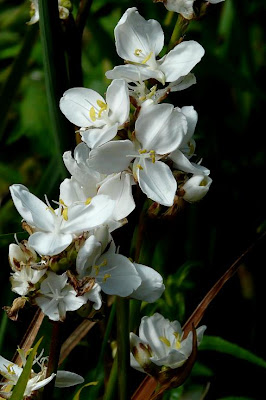
I went out to find a nice Flag Iris and a Raged Robin which had still a fresh flower on it and which was easy approachable too. It is a pity that my Lumix hasn't got one of those flip LCD screens at the back of the camera. From above, I need to take many pictures keeping the lens close to the subject, at an angle to get the best end result. My Lumix has a fairly good macro mode.(even though I want more, of course! In the shape of a Macro lens for the DMC FZ18. That is for dreams at the moment) Mind you, I think the best lesson I learned is not to hold the lens too close to the subject, while zooming out. This Ragged Robin was the only one with just the one reasonable fresh flower which I could use as my subject. Their flimsy texture means that they wilt very easily and start hanging down very soon.

Ragged Robin, Lychnis flos-cuculi

Field Mouse Ear, Cerastium arvense


Dog Rose, Rosa canina


Bush Vetch, Vicia Sepium

It being summer almost, lots of wild flowers are out, and also the Moths have been in and about the house. These three have been calling in last week:

Buff Ermine Moth. Spilarctia luteum,
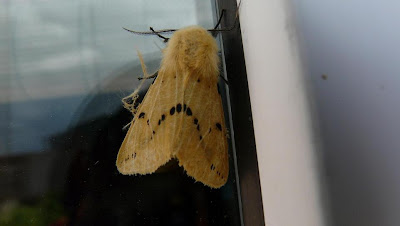

This little Garden Carpet Moth, a common garden variety (hence its name!) has called into the house last year also. I used to call it "Face-Moth however, because of the little face which is marked in the middle of the two front wings.
Garden Carpet Moth, Xanthoroe fluctuata


Small Magpie Moths visits the house often, and now too, it was trying to get and stay indoors. I guess it was seeking shelter from the wind, and the door offers a little shelter, but it obviously was seeking for more. I put it in one of my plant pots, in a little container among the leaves, where it could gather its wings.
Small Magpie Moth, Eurrhypara hortulata


This wild Flower still confuses me; is it a Butterwort, or is it a Mallow? This last one is the family of the garden favourite Lavatera.


On May 30, I came upon the spot where I knew I would find Yellow Flag Iris, one of those wild flowers, which is loved by almost every citizen in the British Isles. Like with the Ragged Robin and Honey suckle. It was hard to believe however that one Flag Iris had already faded flowers, while the next one was still in bud! Another one had faded all over. (and I had been kept indoors due to too much rain until the end of May! Must admit thuogh that they are growing in a very sheltered spot, with trees on both sides of the little road.)


Saturday, May 2, 2009

Flowers, brushstrokes and Lichen

Last week, I stopped when I spotted these yellow flowers. It is rare that I do this with cultivated plants and flowers, as I find their wild cousins (or ancestors in some cases) much more interesting. And think of it, they do not receive extra watering whenever rain has been absent for awhile, nor do they get special fertiliser delivered at their roots at times when they need it most. No, they have to fight their own battle. They have to push their roots out, and further out to find any bit of moisture, and they have to push above ground too, where space is at a premium.
Then the real struggle starts when the time arrives to develop flowers, and not just any flower; It will have to be brighter, emit a stronger scent, and create an easy way of transferring the all important pollen onto the carrier. The Fly, Bee, Moth or Butterfly, which shall hopefully deliver its parcel onto the next flower, eagerly awaiting this fresh dose, in order to guarantee the survival of the species.


As I opened this picture on my laptop, I noticed how the petals resemble brush strokes. I am not sure in which medium these are painted; was it oil, acrylics but I love how the yellow brings out the pale tone of the green background.

What is more, it reminded me immediately of Lottemarie, my late aunt, a sister of my father. She was a lovely person, and she had a great talent of not only create wonderful paintings, but also able to teach others. She taught art at the college. Lottemarie was also a great inspiration to Elly, my lovely friend, and mother.

She and her ex-husband Piet, and his wife,started an art gallery between their two houses, 2 miles from where we lived. This was very new at the time, and certainly the first one in our area of small villages and towns in the heart of Holland.
We, two young girls, would come to the opening nights of the exhibitions, 'twirling' around with the sherry, orange juice and wine glasses. Some years later, when Louise, my sister, got the strings of her new guitar under her belt, we would sing popular songs from bands like Creedance Clearwater Revival.
"Project Maarsbergen" was later handed over to the regional art circle to organise it all, when Lottemarie and her 2nd husband, Cees, withdrew more from it all.
Lottemarie used all kind of medium, oil, watercolour and acrylics. Elly who worked mainly in watercolour, travelled a lot because the flat landscape of the The Netherlands did not manage to inspire her at all. no chance of a tree in the middle of a field there. It is all flat and in straight lines. She therefore loved coming to Ireland and she has created a fair amount of Irish watercolours. Most of her acrylics are abstract. She started doing these only later, a little before we left in the eighties.

A typical Lottemarie in either oil or acrylic.


Could have been an Elly, in watercolour.


I think this Daisy would have challenged Lottemarie into picking up her brush, also.

Ox-eye Daisy,
Leucanthemum vulgare


Another thing Elly liked was Lichen, and I can picture her pen drawing of this Pine cone which must have been lying at the edge of the road for a bit, I think. There was Lichen here on everything on the road, 5cm pieces of bark or broken off a branch. It is a road I pass regularly, when I've brought my camera to the shop and take my time when I pass the hedgerow step for step.
hOwever, there is no hedgerow at this particular bit of road, where the 12 new county council are. So I intend to pass a little faster along thios stretch, on my way home.

Wednesday, March 4, 2009

Wild Spring Flowers

Although I have not been blogging lately, we are doing OK. busy, and with a horrible wind blowing about the house. plus the occasional?? rain showers.
It is a pity because I would love to get out onto the road with my wheels, onto the backroad and to the bay, to check the birds there and before reaching the bay, having a look at the Blackthorn buds, the Aran Lily plants (sorry, cannot find the post) which I photographed last autumn, its variegated leaves a mystery to me, until Roger B. helped me out. And I would like to see how the leaves have grown.
On Monday, I had my camera with me when going to the shop and on my way home I spotted these lovely Lesser Celandine. These are typical spring flowers and they are a good sign of spring as springflower in the wild.
Lesser Celandine:
/>

And although I have not seen any Blackthorn buds yet, on this piece of the back road, because they all grow on the other side, but I did spot these buds of catkins perhaps?


In the garden it is mostly Chaffinches and Chaffinches. usually we see 6 females a day and 3-5 males, and battles are fought on a regular basis. One poor chappie has still a very light breast and he is being hunted by the wrong sex, because it is those with a nice ruddy breast which get the attentions.
Our pale Chaffinch pal:

One of the ruddy, redbreasted Chaffinch males:

He Loves me..., He Loves Me not....,

Some of the ladies:

/>
Pied Wagtail,


Here's Looking At You!
A different view of and JJ,
/>
two of our Blue Tits