Photos

All photos on this blog, Wildlife on Wheels, are taken by me. If you want to use any of my photos for anything other than personal use, send me an email and we'll talk about it. The email address is listed in the sidebar on the right .

Save Dunmanus Bay

Showing posts with label Invertrebrates. Show all posts

Sunday, October 3, 2010

Zebra Spider, Salticus scenicus

Zebra Spider, Salticus scenicus


Jumping Spider males will perform a courtship dance in which they not only wave the front legs, but "but femaleswill pick up the rapid vibration when the dancing male pushes down his abdomen. You can see this dance of another jumping spider specie, in this video.

And if you scroll down to the (almost) bottom photos here, you can see great photos of the Male (right) and Female (left picture) of our Salticus scenicus. The fangs of the male look enormous, which make me think that I got 2 females.

Ajumping spider does not catch its prey in a web, but instead it will stalk its dinner and pounce. Just before the jump, it will attach a silk thread, so it could always get back.

If you are intrigued by Spiders like me, and would love to find names to the pictures, the Spiders of North west Europe is a nice website with lovely photos. At the bottom of the Home Page is a list of other eight legged websites globally.
I love the little Zebra Spiders. As regular readers of Wildlife on Wheels will know. I have a few living around the outside walls of the house, and last year had one inside the kitchen. Despite their 5-7mm size, I usually spot one daily. Whenever I get outside, I do stop at the wall next to the porch, to check if one is there.
And of course, it would not pose for the camera, but rather keep on going wherever they think they need to go. With an incredible speed, while I follow it with the camera!
Another one lives on the other side at the front, always I haven't seen it for a couple of months now. I'm fearing it might be gone, as there were Grasshoppers and the much bigger Garden Spider, living in that corner of the garden also.
I saw them both at the same time in summer, otherwise I might be doubtful it being two different spiders. I've tried looking for individual features, but they are so small, that it is very hard to see on my images, and so I keep guessing.


Also, they are very curious and will often lift their head to observe that silly human who is watching this spider!


This Zebra spider I captured last year on my back wall. So I might have 3 about the place; mind you, I would not be surprised at all, if my one next to the porch had moved north to the back of the house, very near where I took most of the above pictures.

And a Meta segmenta, I'd think. Please correct me if I'm wrong.

Saturday, August 14, 2010

Long legs and a couple of flyers too.


If you know any identities of any of these species, could you leave a comment in the white box below, please?

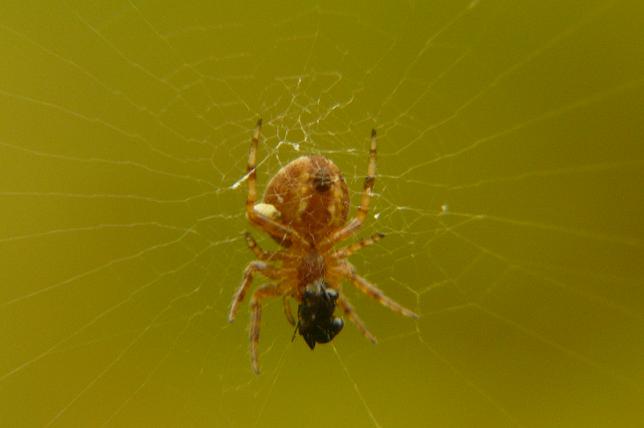
One of the many spiders in the garden. Taking full advantage of the winged critters which get entangled into their webs.


OK, I know; last post featured Spiders too. With all the rain we've had, they are the most prominent among the leaves of the Nettles and Bramble, as they set about repairing and weaving their webs.

Passing the Bramble (with nice juicy black berries at the moment) I spotted this Spider having a big meal out of this Fly, which she had wrapped earlier.)


Garden spider?
Usually it is only the undersides you get to see of Spiders as they sit in their webs.


This scary, yet colourful, Fly was big t 20-222mm. I spotted it in one of the Hebes at the garden at respite, where I was searching for Inects. normally you see very few about the garden, other than houseflies, that is.
It was very orange, which was lovely against the little green leaf of the Hebe. I was surprised to find any Invertebrates there at all; hebes look not very Insect friendly to me! There were some little spiders among the branches also, so there must be food.

While I sat taking photos of Ladybird A, on the right leaf, Ladybird B, here on the left leaf, came running up the stem, around each leaf, until it stopped to catch a breath of Carbon dioxide. (from my breath) not particularly fresh, I'd think!
Anyway, these are two 7-spot Ladybirds, Coccinella 7-puncta
Apparently, the C-7, as the 7 spot is the specie is called also, is the most common Ladybird in Europe.

This Insect, is a stranger to me; it looks as if it is neither hoverfly, nor hopper either. it moves from leaf to leaf with such speed, that i only see it, when it is almost leaving the 2nd leaf, for number 3. Getting a picture was very difficult indeed.
Any ideas as to its identity? I'd really welcome any of these in the comment box, underneath this post.

Monday, August 2, 2010

Spiders in the garden, and Small White Butterfly

If you can help me towards the ID of any of the species in these photographs, can you leave a comment in the comment box below, please?

Repairing some of the damage, caused by the rain. I love those eyes!


I like Spiders, and in fact I like Insects, and Invertebrates. They are intriguing, and I'm amazed at the intricate way they manage to walk. Quite a feat in the eye of a non-walking photographing observer. Once you point the macro-lens onto them, another, more detailed, Spider emerges through the camera and their little faces always make me smile.

And after so much rain recently, it is fun to go outside where web spinning Spiders are busy reparing or, weaving new, webs.
Iam still looking for a European ID website, featuring our UK/Irish Spiders.
This one I captured yesterday.


Now, arethose long fore legs the same as those ofthis one?


Looking from above, it was in an awkward position to photograph, as it was right in the "palm" of the leaf (Bindweed) As you can see, these long front legs do stand out.

The Common Garden Spider, Araneus diadematus is present in most gardens, and in this one alone I got three that I know off.
Some trapeze artist this is!


Sometimes, you'd see long legs onto a wall , a Spider basking in the Sun, or trying to get indoors. Well, this one was also pasted flat in my kitchen doorway.
As I had my lens on the camera, because I had been capturing the female Ants, after they emerged for the flight of their lives. So I did try to get a proper look at it, but this is the best I could manage.
(I had this picture rotated to landscape so you could see the face more detailed, but Blogger does again rotate my photos.
Anyone else having similar problems with uploading their photos?
Anyway, it does look like a very crinkly affair with quite big weaponry up front.


As a kid I had to remove Spiders from the shed so my sister could get her bike out. For my mum I had to remove Flip-flaps (Moths) from her bedroom or any other room. She would panic at the sight of one yet I love Moths and really like Spiders too. Not the big black ones, mind.
Wonder who has created this artwork before the rain and covering the Blackberries. Smart move as the berries must attract a fair few Insects.


At last a few more familiar and less spindly characters of the garden:
Hoverfly.


Red Clover, Trifolium pratense


This Small White, Pieris rapae, came fluttering through the garden, outside my window. I think that the yellow flowered plant, growing in the planter, is a Brassica. I see lots of Small Whites here, and Red Admirals. Small Tortoiseshells too, although less than last year.


Nettle too, is a major attraction in this garden. Bramble they like also. (at least here they do)


Scarlet Pimpernel, Annagallis arvensis


??

Sunday, August 1, 2010

coupling Froghoppers and other invertebrates

If you know, or have an incline to the ID of, any of the unidentified species in this post, could you leave a comment, in the box below, please?

First of all, I have to thank Liz for identifying these tiny critters.
Froghopper or Spittlebug, the last name due to their ability of the nymph to suck sap from the plant, and shelter within this "foam or "spittle".
I'd been inbetween the Nettles, Urtica dioica, and Common Bird'sfoot Trefoil, Lotus comiculatus, and went indoors to get a new battery for the camera. Outside again, I spotted this hitch hiker. It had travelled a fair distance with me. This was the second time that one took a fancy to the control panel of my wheels.


On the 19th of July, I found these two Fro'hoppers, being cosy together and I suspect that their coupling will produce the next generation. Assuming that I am seeing things right? Mind, it seems an odd way they are connected to each other.


A few leaves further, another couple being intimate?
Another hopper.

This Insect in my garden, had a yellow heart-shaped triangle on its back; more or less like the Insect I had seen inside the Wild Angelica, Angelica sylvestrus, The difference being that this Insect is flat and the other one was more long and 'round'.


These 'flies' i like too. Perhaps it is the markings on the thorax?


Zebra Spider, Salticus scenicus
One of 3 Zebra Spiders living here in the garden/house. (in last winter one the warmth of the house seemed to win one over to come indoors. ) They are jumping spiders which stalk their prey before pouncing down on it. They can jump a fair distance too. This way they don't have to spin a web to catch prey.


This mollusc? or whatever it is, I found on one of the Bindweed leaves, Calestegia sepium. It has these impressive grooves, running over its body, diagonally. It was about 50-70mm long.


Bindweed itself.